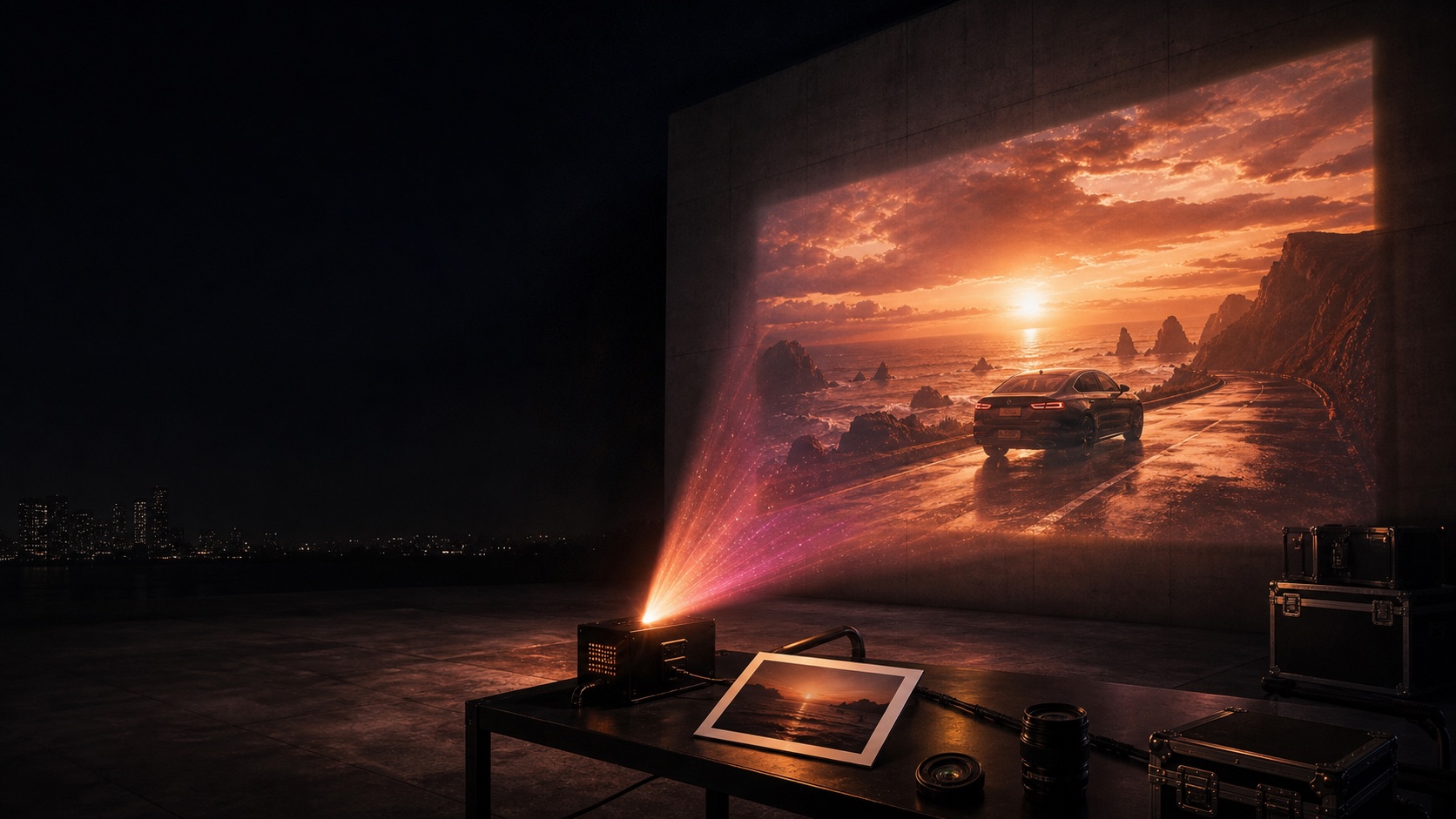
A 14-week production schedule used to be a constant. A reshoot used to be a crisis. In 2026, neither has to be true — and the studios learning that fastest are about to take a generational share of the market.
- 01Location, reshoots, and localisation have become cheap in sequence — these three cost centres drove most of the old timeline.
- 02The director's craft moves earlier: more time in direction and daily review, less time on set.
- 03Sound design matters more, not less — with visuals easier to iterate, audio does more of the tonal heavy lifting.
- 04The new bottleneck is taste: when everyone has access to the same models, editorial sensibility is the differentiator.
- 05Broadcast acceptance is broadening — the FTC signals 'label, don't ban.'
The old timeline
In 2024 the average global TVC took 14 weeks from approved board to broadcast master. Two of those weeks were lost to scheduling. Three were lost to location and crew availability. Four were lost to post. The remaining five — actual shooting and editing — were where the craft lived. Everyone agreed it was too slow, and everyone agreed there was nothing to do about it.
This is the moment that broke. Not all at once, and not because some new model dropped. The timeline broke because the things that used to be expensive — scheduling, location, reshoots, localisation — became cheap in a sequence, and the ones that stayed expensive (craft, taste, direction) became more visible.
What follows is a working theory of how production schedules are collapsing, where the craft is moving, and what marketing leads should be planning for through 2027.
What collapsed first
Location was first. Once a director could generate a credible interior or exterior in any era, in any weather, with any wardrobe, the scheduling drag of permits, scouts and unit moves stopped being load-bearing. Most of our 2025 work didn't visit a location at all.
Reshoots collapsed next. The most expensive call sheet line in traditional production has always been "let's do that again on Tuesday." Iteration inside the AI scene composer is so close to free that the team's posture changes — you stop guarding against revisions and start using them.
The best commercials of the next decade won't be made by AI or by humans. They'll be made by directors and editors using AI the way previous generations used optical printers, motion control, or CGI — as a creative instrument that opens up shots, locations, and ideas that weren't possible before.— From our 2026 manifesto
Localisation was the third collapse. The traditional path was: shoot the hero, dub the VO, swap the supers. The new path is: generate the hero with localisation as a first-class output. Lip-sync is baked in. On-screen text and packaging adapts per market. We routinely deliver 12 languages from a single source.

The new pipeline
Inside our studio, every project moves through the same five stages — brief, direction, AI production, edit & sound, delivery. The stages haven't changed; the time inside each stage has. Brief and direction are longer than they were in 2023, and production is dramatically shorter.
What lengthens
- →Briefing and reference selection — every decision pulls forward
- →Creative direction and storyboarding — three routes per pitch, not one
- →Final picture lock — knowing when to stop is harder when iteration is free
What compresses
- →Pre-production logistics — locations, scouts, permits, crew
- →Principal "shoot" time — replaced by generation cycles
- →Reshoots — the workflow now, not the exception
- →Localisation — built in, not bolted on
Where craft moves
Direction moves earlier. The most senior person on the project — the director — used to spend the majority of their time on set. Now they spend it in pre-production and in the daily review of generated material. The output is the same; the touch is different.
Edit stays roughly where it was. The film still needs to feel like a film, and the cut still does the lifting on pacing and emotion. What changes is that the editor can ask for new shot variants and have them by morning — the cutting room becomes more elastic.
Sound matters more, not less. Audio is still ~30% of the perceptual quality of a finished commercial, and now that the visuals are easier to iterate on, the sound design has more room to do the heavy lifting on tone.
Outlook for 2027
Looking out 18 months, three things are obvious to us: broadcast acceptance is broadening; the agency model is changing; and the new bottleneck is taste. When everyone has access to the same models, the differentiator is the director, the brief, and the editorial sensibility behind the work.
None of this is a victory lap. It's a working memo. Send us your reactions — we'll publish a follow-up with what the next 12 months look like from your seat, too.